The Universe
To Scale
“The size and age of the Cosmos are beyond ordinary human understanding.”— Carl Sagan
Five ways to feel the scale of reality — drawn with nothing compressed or skipped. Where would you like to begin?
A Solarc Productions project
Built with care, with AI, and with honesty about both.
This is a free educational project. In the spirit of a good scientist, here's exactly how it was put together — and where to be skeptical.
The words & the code
Conceived, designed and directed by Solarc Productions. The writing and the code were produced in collaboration with Claude, an AI assistant by Anthropic. Every figure was checked against real sources, but a human set the intent and the voice.
The images
The globes of the planets, the Moon, the Sun and the Pale Blue Dot are real NASA / JPL-Caltech imagery. And where an event is a real photograph or observation — the first image of a black hole, the Apollo Moon landings, the cosmic microwave background, the first powered flight — we show the actual image, credited to its source. Everything else — the animals, the deep-time events, the far-future scenes — are original AI-generated artworks made for this project: grounded in the real science, but artist's impressions, not photographs. Where no photograph is possible (a dinosaur, the birth of the Moon, the end of the Sun), an honest illustration is the best we have.
The data
Ages, sizes and distances reflect current scientific consensus, drawn from NASA, ESA, the IAU, Wikipedia / Wikimedia Commons and the peer-reviewed literature. Deep-future and speculative items are flagged as such where they appear.
The assumptions — and the mistakes
Drawing the whole universe to scale means making choices: rounding numbers, picking one figure where scientists still debate a range, and compressing the truly un-drawable. Science also moves — records fall, estimates shift. So there may be errors here. If you find one, it's ours to fix — the project is updated as mistakes come to light and as the science advances. Hold it all with wonder, and a little healthy doubt. That's the whole point.
From the Planck length to the whole observable universe — and you can't see two ends at once.
—
Numbers so large they stop meaning anything — until you find the right comparison.
—
Almost all of space is empty space — and even light, the fastest thing there is, crawls across it.
Nothing outruns light — and the closer you push toward it, the more your own time slows for everyone watching.
You are not separate
from the universe.
You are made of it.
Take a breath. Set down the weight of the day for a moment, and let the scale of things settle over you.
“Dwell on the beauty of life. Watch the stars, and see yourself running with them.”Marcus Aurelius, Meditations, c. 175 CE
We arrived only a heartbeat ago
The universe is 13.8 billion years old. Squeeze all of it into a single year, and the first humans don't appear until the last hour of December 31st. Every empire, every war, every cathedral, every love story, every name in every history book — all of it happens in the final few seconds before midnight. You are reading this in the opening instant of the new year. We are astonishingly, impossibly new.
And yet — new as we are — we have been looking up, and losing ourselves, for as long as we have been here.
“Mortal as I am, I know that I am born for a day; but when I follow the serried multitude of the stars in their circular course, my feet no longer touch the earth.”attributed to Ptolemy, Greek Anthology, c. 150 CE
And we are unimaginably small
In 1990, as it sailed beyond the planets, the Voyager 1 spacecraft turned its camera back toward home from six billion kilometres away, and photographed the Earth. It came back as a single pale blue dot — less than one pixel — lost in a scattered ray of sunlight.
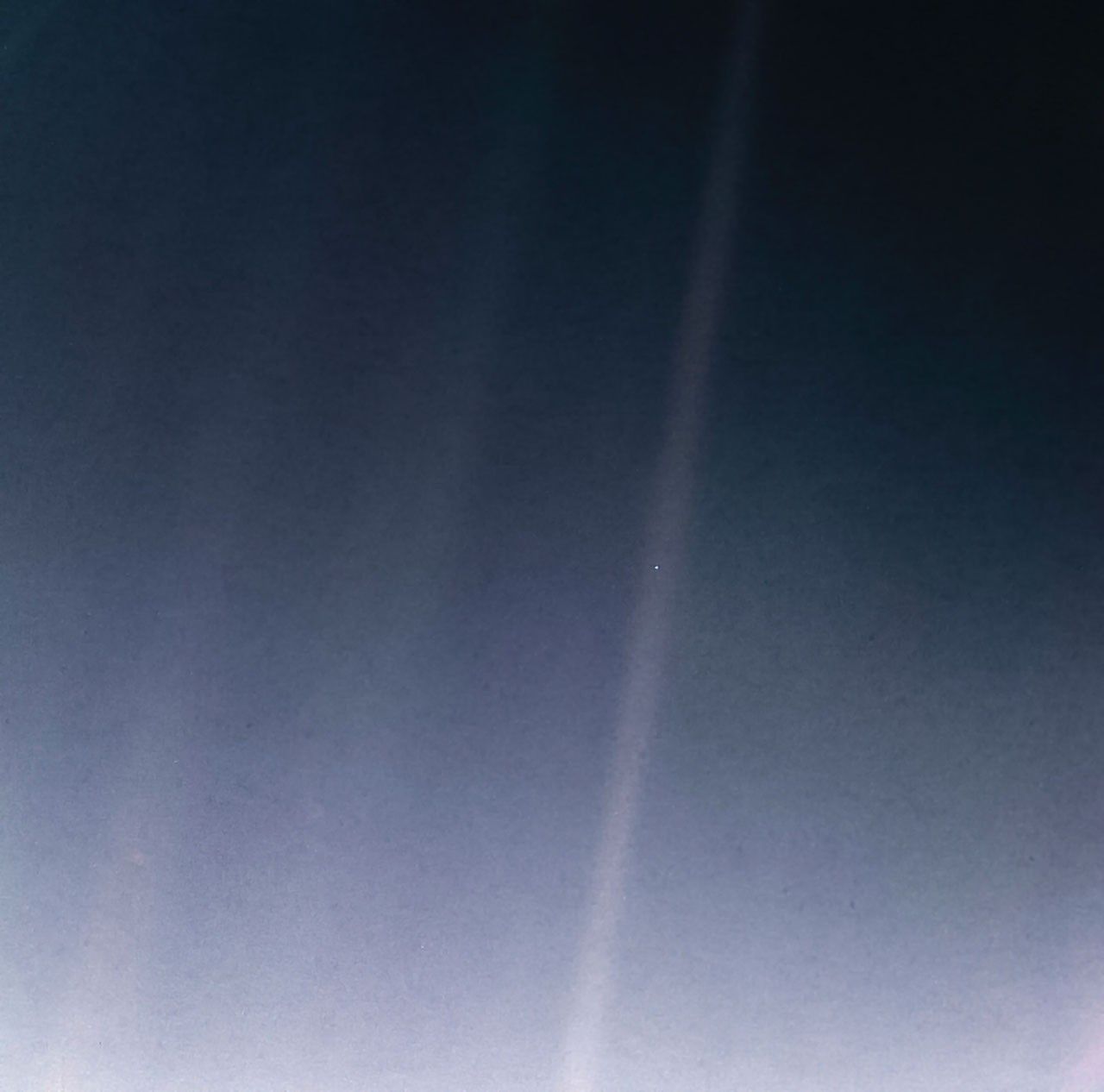
“Look again at that dot. That's here. That's home. That's us. On it everyone you love, everyone you know, everyone you ever heard of, every human being who ever was, lived out their lives… a mote of dust suspended in a sunbeam.”Carl Sagan, Pale Blue Dot
“To see a World in a Grain of Sand
And a Heaven in a Wild Flower,
Hold Infinity in the palm of your hand
And Eternity in an hour.”William Blake, Auguries of Innocence, c. 1803
But here is the turn
That smallness could feel like loneliness. It shouldn't. Because you are not a visitor to this universe, peering in from the outside. You are of it, woven from its oldest threads.
The hydrogen in the water you drank this morning was forged in the Big Bang itself, 13.8 billion years ago. The oxygen filling your lungs, the carbon in your hands, the calcium in your bones, the iron coloring your blood — every one of those atoms was cooked inside an ancient star, then flung across space when that star died, drifting for billions of years before gathering into the cloud that became the Sun, the Earth, and you.
The atoms that make you are nearly as old as time. You are not separate from the stars. You are them — briefly gathered into someone who can wonder.
Humanity has known this in its bones far longer than it has known the physics. Twenty-seven centuries ago, teachers on the Ganges compressed it into three words. The Taoists said it with a laugh. Whitman sang it. Only the mechanism — the stellar furnaces, the supernova seeding — is new.
“Tat tvam asi — thou art that.”Chāndogya Upaniṣad, c. 700 BCE
“Heaven and earth were born together with me, and the ten thousand things and I are one.”Zhuangzi, c. 300 BCE
“I believe a leaf of grass is no less than the journey-work of the stars.”Walt Whitman, Leaves of Grass, 1855
A way for the universe to know itself
For 13.8 billion years the cosmos expanded and cooled, lit its first stars, spun up galaxies, forged the elements, and seeded the worlds — all of it in silence, with no one to see. And then, in the last thin sliver of the last era, on one small wet rock orbiting one ordinary star, the star-stuff opened its eyes.
You are how the universe sees its own galaxies. You are how it feels the warmth of its own star. The awe you feel looking up at the night sky is the cosmos marveling at itself — through you.
“The same stream of life that runs through my veins night and day runs through the world.”Rabindranath Tagore, Gitanjali, 1912
“For small creatures such as we the vastness is bearable only through love.”Carl Sagan, Contact
We have so little time here — a flicker, a butterfly's single day. But two thousand years ago Lucretius noticed something kind hidden in that fact: you were absent for an eternity before you were born, and it never hurt you at all.
“Look back at the eternity that passed before we were born, and see how utterly it counts to us as nothing.”Lucretius, De Rerum Natura, c. 55 BCE
So look at the people beside you. Look at this strange, improbable, breathtaking world. Every living thing on it is made of the same ancient atoms, all of us woven from the same exploded stars. We are not strangers in the cosmos. We are the cosmos, and we belong here.
Welcome home.
We may be thinking
about time all wrong.
The timeline you just travelled is the best story our species can tell right now. But peer underneath it, at the laws that run the cosmos, and reality turns out to be far stranger — and stranger still the closer you look.
First, a confession
Everything on these screens is our current best guess — drawn from real evidence, but resting on assumptions: that the laws of physics are the same in every place and every age, that the patch of universe we can see is typical of the whole. Every grand picture of reality humans have ever held was eventually deepened or overturned. So hold this one with wonder, and a little humility. We are a very young species, still learning to see.
This humility is not new. The oldest surviving creation hymn — three thousand years old — ends not with an answer but with a shrug at the sky:
“Whence this creation arose — perhaps it formed itself, perhaps it did not — he who surveys it from highest heaven, only he knows. Or perhaps even he does not know.”Rig Veda 10.129, the Nasadiya Sukta, c. 1200 BCE
Why time even has a direction — entropy
Of all the laws, one quietly rules the whole timeline: the second law of thermodynamics. Left alone, disorder — entropy — almost always increases. A cup shatters but never reassembles; heat spreads but never gathers back.
The universe began in an almost unimaginably ordered, low-entropy state at the Big Bang, and has been spreading out ever since. That one-way slide is the arrow of time. It's why you remember the past but not the future, why the story runs from order toward the long, cold evenness of heat death. Time's direction may be nothing grander than the universe running downhill.
“The law that entropy always increases holds, I think, the supreme position among the laws of Nature.”Arthur Eddington — who named “the arrow of time” — 1928
And life? Life helps it run downhill faster
Here's the twist you may have half-remembered. A living thing looks like a rebellion against the second law: it builds and maintains exquisite order — cells, bodies, cities — when everything is supposed to be falling apart. But it isn't a rebellion. It's the opposite. To hold itself together, a living thing must constantly take in usable, low-entropy energy and pour out far more disorder than it locks up. You stay ordered by dumping a surplus of entropy — waste heat, spent chemistry — into the world around you. The books always balance in entropy's favor.
So you can flip the whole picture. Earth sits in a torrent of low-entropy sunlight and radiates it back to cold space as a much larger spray of heat. Life is one of the most efficient ways found yet to speed that conversion up — a structure that decreases entropy locally, for a while, precisely so the universe can increase it globally, faster. We are not exempt from the slide toward heat death. We are, in a real thermodynamic sense, the universe's way of getting better at it: pockets of fleeting order whose whole function is to dissipate energy more thoroughly than bare rock ever could.
This isn't fringe. Schrödinger framed it in 1944 — life "feeds on negative entropy." Ilya Prigogine won a Nobel Prize for showing how ordered "dissipative structures" arise naturally in energy flows. And more recently the physicist Jeremy England has argued that under a steady drive of energy, matter will tend, on its own, to restructure itself into ever-better dissipators — hinting that the emergence of something life-like may be less a fluke than a thing the second law quietly favors.
“Life feeds on negative entropy… It is by avoiding the rapid decay into the inert state of equilibrium that an organism appears so enigmatic.”Erwin Schrödinger, What Is Life?, 1944
There is no universal “now” — relativity
Einstein discovered that time is not the same for everyone. Clocks tick slower the faster you move, and slower still deep in gravity. This isn't a trick — it's measured every day: the GPS satellites above you must correct their clocks, and astronauts return a fraction of a second younger than they'd have been on Earth.
Stranger yet: two people moving differently genuinely disagree about which distant events happen “at the same time.” There is no single, universal present ticking through the cosmos. Space and time are not separate stages — they are one woven fabric: spacetime.
“The distinction between past, present and future is only a stubbornly persistent illusion.”Albert Einstein, 1955
The block universe
If there is no universal “now,” then perhaps every moment — the Big Bang, this breath, the last star going dark — exists equally, all at once, as a single four-dimensional block. The past and future would be as real as the present, just elsewhere in the block, the way Paris is real even while you stand in Tokyo.
In this view — called eternalism — time doesn't flow at all. The whole of history simply is, a fixed landscape we could in principle wander the way we wander 3-D space. It remains debated, not settled. But it follows naturally from relativity, and many physicists take it seriously.
“Time is the substance I am made of. Time is a river which sweeps me along, but I am the river.”Jorge Luis Borges, A New Refutation of Time, 1946
Then why does time seem to flow?
Sixteen centuries ago Augustine already knew exactly where the mystery lived:
“What then is time? If no one asks me, I know; if I wish to explain it to him who asks, I do not know.”Augustine, Confessions, c. 400 CE
Here is the most beautiful possibility, and the most uncertain: maybe the passage of time isn't something the universe does — it's something minds do. We never perceive the whole block. We experience a single, sliding frame — a bright “now” — moving along a film that already exists in full.
Perhaps consciousness simply is the experience of moving through the block, one moment at a time. Whether that's physics or only the shape of perception, no one yet knows. It sits exactly where physics meets the deepest mystery we have: what it is to be aware at all.
Underneath, reality is probability — the quantum
Zoom in far enough and solidity dissolves. Particles aren't tiny marbles; they are clouds of possibility, existing in many states at once until something measures them. Particles can be entangled — linked so that measuring one instantly tells you about the other, across any distance — what an uneasy Einstein called “spooky action at a distance.”
What “measurement” even means, and why a definite world crystallises out of all that probability, is still one of the deepest unsolved problems in science.
“I think I can safely say that nobody really understands quantum mechanics.”Richard Feynman
And maybe it's all a hologram
The strangest serious idea of all came from studying black holes. Physicists found that the most information a region of space can possibly hold isn't set by its volume — but by its surface area. That clue grew into the holographic principle: that the entire three-dimensional reality inside a region might be fully encoded on its two-dimensional boundary, like a hologram.
In 1997 Juan Maldacena made a precise mathematical version of this idea, and it has reshaped theoretical physics ever since. It hints that depth — perhaps even gravity itself — could be a kind of projection of information living on a distant surface. We don't know if our universe truly works this way. But the mathematics is taken very, very seriously.
And 95% of it is missing
Here is perhaps the most humbling fact in all of science. Everything you've travelled through on these screens — every star, planet, person and atom — is only about 5% of the universe. The other 95% is two things we've named but cannot explain.
Dark matter is unseen mass — five times more than all the visible stuff — whose gravity holds galaxies together; we know it's there only by how it pulls. Dark energy is stranger still: a force woven into empty space that is pushing the universe apart faster and faster. We have never directly detected either one. The entire glowing cosmos we've mapped is the thin bright sliver on the left.
Where it all converges
Entropy, relativity, the quantum, information, holography — follow any thread far enough and they tangle at the same knot: a missing deeper theory, quantum gravity, that would finally tell us what space, time, and reality actually are. We don't have it yet.
What we have is a timeline drawn in the best ink of our age, by creatures who arrived a heartbeat ago and are still opening their eyes. The honest, thrilling truth is that the universe is almost certainly stranger and more beautiful than anything on these screens — and we get to keep finding out.
“The universe is not only queerer than we suppose, but queerer than we can suppose.”J. B. S. Haldane
Keep wondering.
Built on the work
of thousands.
Nothing here is original science. Every date, size and image is drawn from generations of astronomers, geologists, biologists and historians — and from the institutions that share their work freely.
Created by
Conceived, designed and directed by Solarc Productions — code written and built with Claude (Anthropic).
Imagery
The Earth, Moon and Sun globes, the planetary textures and the Pale Blue Dot are courtesy of NASA / JPL-Caltech (public domain). The earliest-galaxy science draws on the JWST mission — NASA, ESA, CSA. The event and object illustrations are original AI-generated artworks created for this project, grounded in the underlying science and hosted with the site — open any event and follow “Read more on Wikipedia” for the sources behind the story itself.
Words & quotations
Marcus Aurelius (Meditations), William Blake (Auguries of Innocence), Walt Whitman (Leaves of Grass) and Carl Sagan (Pale Blue Dot, Contact) on the cosmic perspective; Albert Einstein, Richard Feynman, J. B. S. Haldane and Erwin Schrödinger on the nature of reality — all brief, attributed excerpts quoted under fair use.
Data & science
Ages, sizes and distances reflect current scientific consensus, drawn from NASA, ESA, the IAU and the peer-reviewed literature. The 13.8-billion-year history, the geological and evolutionary dates and the near-future projections are mainstream science; deep-future and speculative items are flagged as such where they appear.
How we actually know
These aren't guesses. Radiometric dating — the steady decay of unstable atoms — clocks rocks and meteorites. Parallax and standard candles ladder outward to measure distances. Redshift reveals the universe's expansion and its age. And the cosmic microwave background — the oldest light there is — lets us see almost all the way back to the beginning.
Sound
The ambient score was composed for this project.
A note on reuse
This is a free, non-commercial educational project. NASA imagery is public domain; Wikimedia images each carry their own licence (mostly Creative Commons). If you reuse anything, please honour those licences and credit the original creators.
Thank you, to everyone who looked up first.
13.8 billion years, drawn at true scale — nothing compressed or skipped. Everything you've ever heard of is crammed into the last sliver. Drag to travel, scroll to zoom, tap any milestone for the story, and press ▶ Tour to fly through it.
- Conceived, designed & directed by Solarc Productions — code written & built with Claude (Anthropic)
- Planet, Moon, Sun & Milky Way textures — Solar System Scope, CC BY 4.0
- Event & object illustrations — original AI-generated artworks made for this site; planet & Moon textures — NASA / JPL-Caltech
- Timeline facts & summaries — Wikipedia
- Explainer videos — via YouTube (Kurzgesagt, PBS Eons, TED-Ed, NASA & others)
- Type — Space Grotesk & IBM Plex Mono (SIL Open Font License)
- Ambient soundtrack — original music for this site, looped from to-scale-music.mp3
Made with care as a free gift to the curious. If it gave you a little perspective, you can help keep it online.